 AI Ed
AI Ed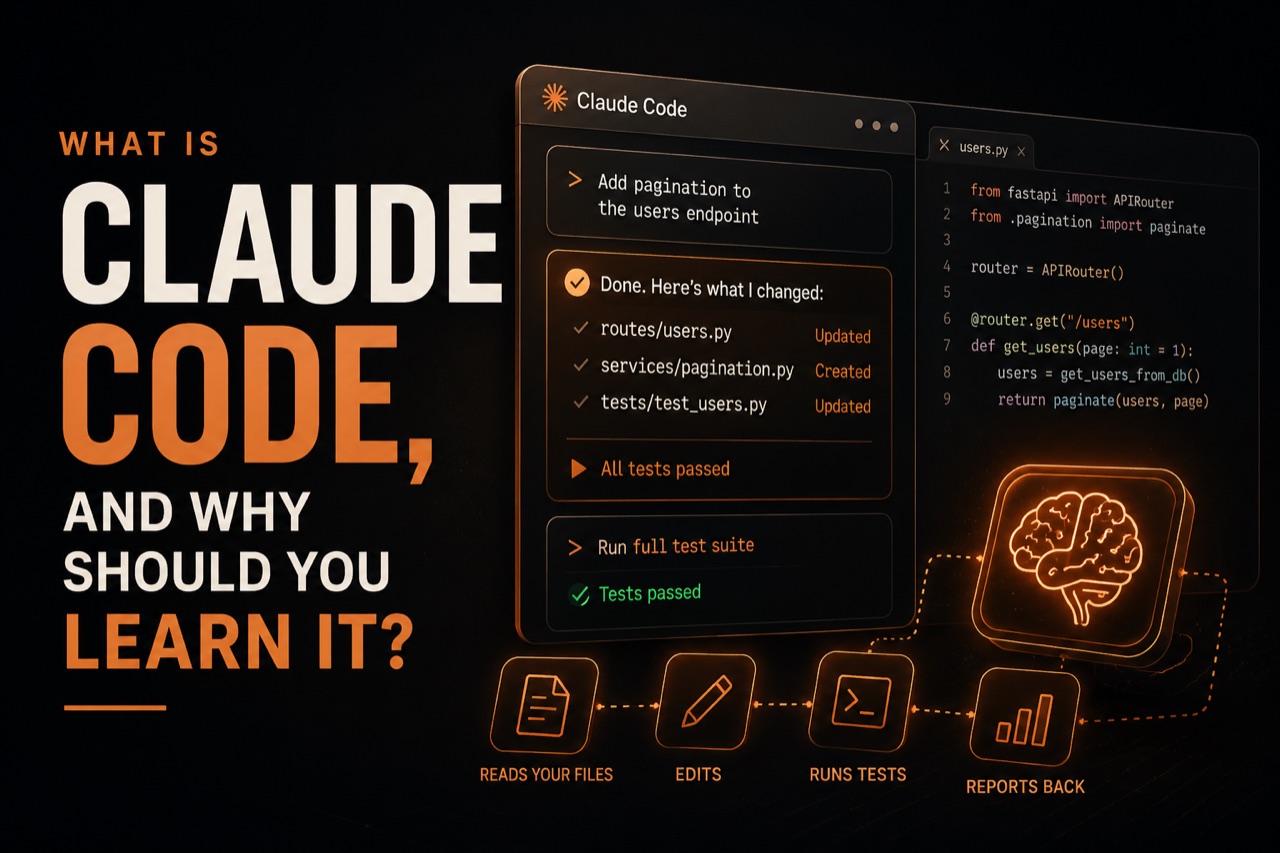
Claude Code
Your First Agentic Coding Session with Claude Code
You've opened a large language model before. Maybe you typed in a question, got an answer, and that was that. But what if you could ask it to do more than just answer? What if you could ask it to think through a problem, create a plan, write some code, test it, and then fix it if it didn't work?
This isn't science fiction. This is the world of agentic AI, and with Claude Code, it's surprisingly accessible for beginners. Today, we'll walk you through your very first agentic coding session, turning Claude from a helpful chatbot into a coding assistant that can tackle tasks with a degree of autonomy.
What is Agentic AI?
At its core, an AI agent is a system designed to achieve a specific goal by performing a series of actions. Unlike a simple chatbot that responds to one-off prompts, an agent can:
- Plan: Break down a complex goal into smaller, manageable steps.
- Execute: Carry out those steps, often interacting with tools or environments (like a code interpreter).
- Observe: Check the results of its actions.
- Reflect: Evaluate its progress, identify errors, and adjust its plan or actions if needed.
Think of it like this: instead of asking Claude, "Write me a Python script to calculate factorials," you ask, "Write a Python script to calculate factorials, and make sure it handles non-integer inputs gracefully." The agent then plans how to do this, writes the code, tries it, notices if an error occurs with a non-integer, and then revises its code to add the error handling.
Why Learn Agentic Coding with Claude?
Claude stands out for its strong reasoning abilities and its capacity for long context windows, which are crucial for agentic workflows. When an agent needs to plan, remember past actions, and reflect on results, a good memory and logical processing are key. Claude's conversational style also makes it easier for beginners to interact with and guide the agent through its tasks.
Many developers and researchers are exploring agentic AI. You can learn more about its principles from resources like the official Anthropic blog, which discusses the underlying models and their capabilities. It's a foundational skill for interacting with the next generation of AI tools.
Your First Agentic Mission: Calculating Factorials
For our first agentic session, we'll give Claude the task of writing a Python function to calculate the factorial of a number. But here's the agentic twist: we'll also ask it to include error handling for inputs that aren't positive integers.
Step 1: Define Your Goal Clearly
The clearer your goal, the better your agent can plan. For this session, our goal is:
"Write a Python function called
calculate_factorialthat takes one argument, a number. It should return the factorial of that number. Crucially, it must handle cases where the input is not a positive integer by returning an informative error message instead of crashing."
Step 2: Give Claude its Role and Instructions
When you prompt Claude, it's helpful to explicitly tell it to act as an agent. This primes it for a multi-step process. We'll also ask it to think step-by-step.
Open Claude and type something like this:
"You are an AI programming agent. Your task is to develop a robust Python function. Think step-by-step to plan, write, and test the code. Your goal is to create a function called `calculate_factorial` that takes a single number as input. It must compute the factorial for positive integers. For any input that is not a positive integer (e.g., negative numbers, decimals, text), it should return a string like 'Error: Input must be a positive integer.'"
Step 3: Watch it Work - The Planning Phase
Claude will likely respond by outlining its plan. It might look something like this:
- Plan:
- Define the function signature:
calculate_factorial(num). - Implement input validation: Check if
numis an integer and positive. - If validation fails, return the specified error message.
- If validation passes, calculate the factorial using a loop or recursion.
- Return the result.
- Write example test cases to verify both valid and invalid inputs.
- Define the function signature:
This planning step is a core part of agentic behavior. It shows Claude breaking down the problem before it even touches the code.
Step 4: The Coding and Testing Phase
After the plan, Claude will proceed to write the code based on its own strategy. It will likely generate the Python function and then, because we asked it to think step-by-step and test, it will also provide example usage or test cases.
For instance, it might generate:
def calculate_factorial(num):
    if not isinstance(num, int) or num < 0:
        return "Error: Input must be a positive integer."
    if num == 0:
        return 1

    factorial = 1
    for i in range(1, num + 1):
        factorial *= i
    return factorial

# Test cases
print(f"Factorial of 5: {calculate_factorial(5)}")      # Expected: 120
print(f"Factorial of 0: {calculate_factorial(0)}")      # Expected: 1
print(f"Factorial of -3: {calculate_factorial(-3)}")    # Expected: Error message
print(f"Factorial of 3.5: {calculate_factorial(3.5)}")   # Expected: Error message
print(f"Factorial of 'abc': {calculate_factorial('abc')}") # Expected: Error message
Step 5: Review and Refine
This is where your human intelligence comes in. Copy Claude's code into a Python interpreter or a simple script file and run it. Do the test cases work as expected? Does the code meet all the requirements you set?
If you find an issue, or want to add another feature, you can tell Claude:
"That's great! Now, can you also add a check to ensure the input number isn't too large, say, above 20, as factorials grow very quickly and might cause an overflow or take too long to compute? If it's too large, return 'Error: Input number too large for calculation.'"
Claude, acting as an agent, will then take this feedback, update its plan (implicitly or explicitly), modify the code, and likely provide new test cases for the 'too large' scenario. This iterative process of plan, execute, observe, and reflect is the essence of agentic coding.
Overcoming Beginner Hurdles
Starting with agentic coding can feel like a big step, but it's really about clear communication and iterative refinement. Here are a few tips:
- Be Specific: The more detailed your initial prompt, the better Claude can plan.
- Break It Down: For very complex tasks, start with a smaller, simpler goal and then add complexity in stages.
- Provide Examples: If you have specific input/output expectations, include them.
- Iterate: Don't expect perfection on the first try. Agentic coding thrives on feedback and refinement. This mirrors how real software development works.
For more on how to structure your prompts effectively, check out our post on Prompt Engineering for Beginners.
Why AI Ed for Your Agentic Journey?
Learning agentic coding requires practice and consistent effort. However, traditional courses often demand long, uninterrupted blocks of time that are hard to find in a busy schedule. This is where AI Ed comes in. Five-minute lessons that fit a real day, not 45-minute desktop courses you abandon, make it easy to build a daily learning habit.
You can learn the fundamentals of Claude Code, understand agentic principles, and build real skills in short, engaging bursts. Our gamified approach, with a plant that grows as you maintain your learning streak, provides visible progress and accountability that helps you stick with it.
Start your journey into agentic AI and machine learning today with AI Ed, where you can complete daily five-minute lessons, grow your plant streak, and earn certificates.